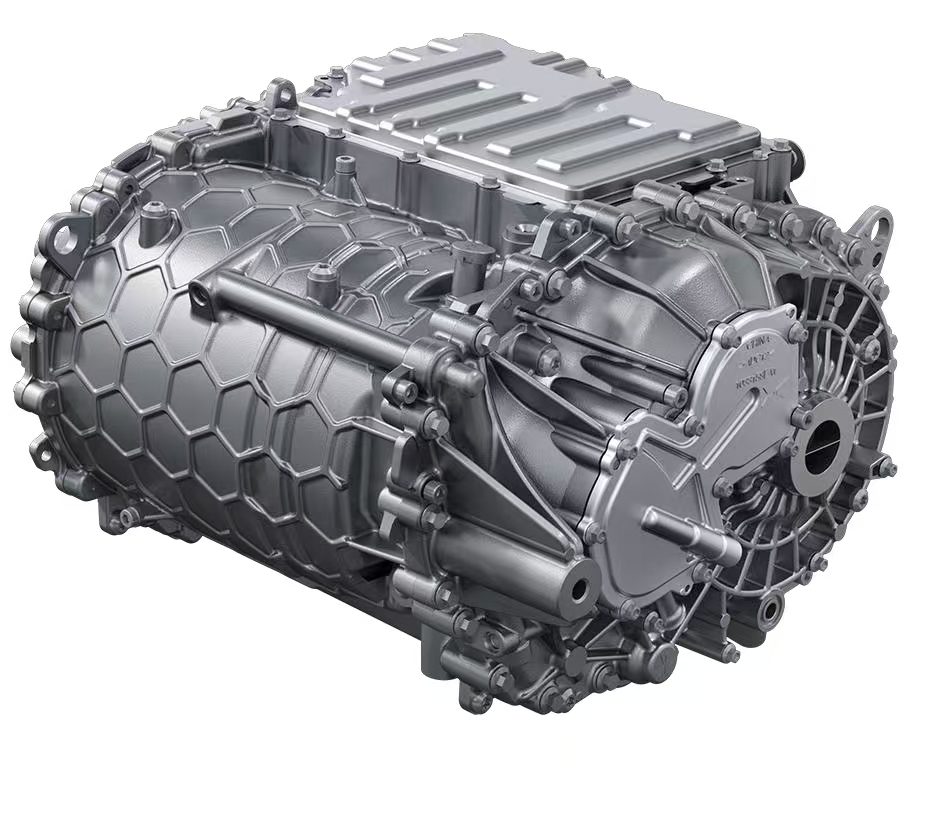
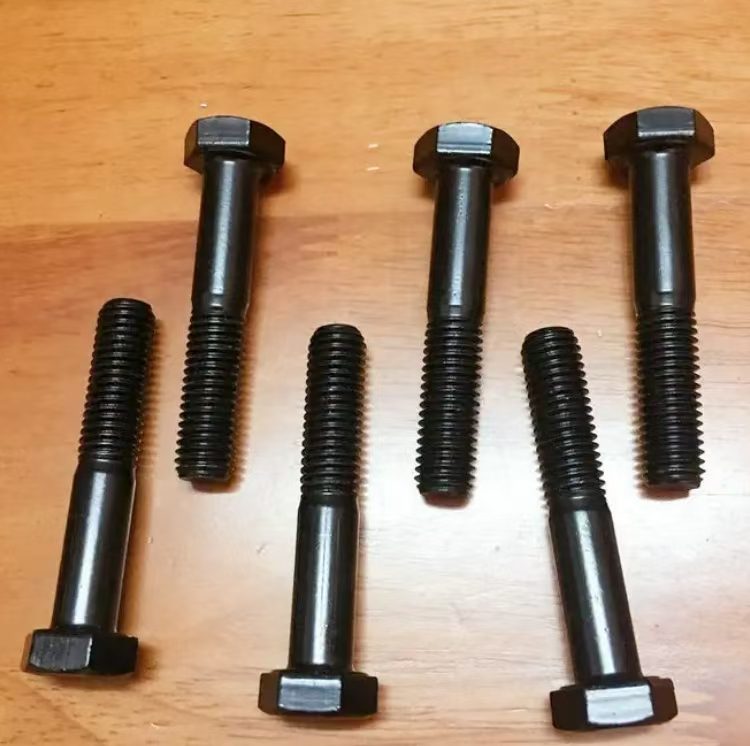
Fasteners in the drive unit face heat from two directions: operating temperature, and the dehydrogenation bake after plating. This page works backwards from the failure symptoms to what a sealer actually has to survive in an EV programme.
Most failure analyses look at one of them. In an EV programme they stack.
Property class 10.9 / 12.9 fasteners must be baked after zinc plating, typically 190–220 °C for several up to twenty-plus hours; some specifications go higher or longer, with the upper band around 250 °C. The bake is what lets hydrogen diffuse out — it cannot be skipped.
Drive-unit power density keeps climbing. Winding insulation class tops out around 180 °C, housing, gearbox and adjacent regions can see above 200 °C in peak operation, and e-drive parts additionally go through the OEM's thermal cycling and shock tests.
The film loses water and degrades in the oven; appearance shifts first, performance follows. This is the earliest signal, and it shows up before the salt-spray shortfall.
Production parts spend longer in the oven, or at a higher setpoint, than the qualification lot — the film was already damaged before the cabinet.
A softened or locally worn film changes the friction coefficient; the same torque gives a different clamp load, and EV assembly lines are sensitive to exactly this.
Most sealers crosslink an organic resin or silicate matrix; residual water and solvent are part of the film.
Hours at 190–250 °C dry the film out, shrink it and degrade the resin; the crosslinked structure breaks down.
Once the film cracks, corrosive media reach passivation and zinc directly — white rust arrives long before the specified hours.
| Requirement | Why it matters here specifically |
|---|---|
| 1 · No discolouration or cracking at 250 °C bake | Dehydrogenation cannot be skipped; the film has to live through the oven |
| 2 · Corrosion resistance retained after the bake | Pre-bake salt-spray figures are meaningless; the customer inspects baked parts |
| 3 · Stable, reproducible friction coefficient | The film is the friction face; scatter equals batch risk on torque-controlled joints |
| 4 · Calculable working concentration and drag-out | Program quotations need a defensible cost per square metre before the drum price matters |
| 5 · Ambient operation, no pH trimming | Every removed heating and control loop is one fewer thing to go wrong |
The list above is the design brief of GT-Sealer 501HT — a water-based zinc sealer made for lines with a dehydrogenation bake.
| Parameter (datasheet / supplier-confirmed) | Value |
|---|---|
| Heat behaviour | No discolouration at 250 °C bake; corrosion resistance retained after dehydrogenation |
| Type | Water-based, organic–inorganic hybrid zinc sealer |
| Working concentration | 100–400 ml/L |
| Operation / pH | Ambient to 40 °C; pH 7.5–10 normally needs no trimming |
| Friction coefficient | 0.13–0.18 |
| Substrates | Zinc, zinc-nickel, zinc-iron, zinc-cobalt, zinc alloys, aluminium (after trivalent passivation) |
Source: product datasheet and supplier-confirmed figures, reproduced without adjustment; salt-spray hours depend on the system and must be verified on your parts.
The film does not rely on a single organic resin: the inorganic fraction carries the structure at high temperature while the organic fraction keeps flexibility and pore sealing. After a 250 °C bake the film stays intact, so the salt-spray figure does not collapse with dehydrogenation. Working concentration is a fraction of conventional sealers, the bath runs at ambient temperature and the pH needs no trimming — each of the five requirements above, answered point by point.
It varies by OEM and component; 480 to 720 hours of neutral salt spray is a common band for automotive fasteners, with e-drive related parts often specified tighter. The drawing and the OEM standard decide — this site does not quote guaranteed figures.
All four process routes carry a cost, and the right one depends on whether the sealer survives the bake. See the process page for the full comparison of the four routes.
On this page, 250 °C refers to the upper band of the dehydrogenation bake; operating temperature is a separate heat source. Screen candidates against both, and design to the harsher one.
Three checks: whether the working concentration fits the existing make-up and dosing setup, whether heating and pH control loops can be removed, and whether the bake step can be merged with sealing. Start with a small-batch trial at the middle of the concentration range.
Tell us the plating type, passivation, salt-spray requirement and whether the part is baked. We will give you a technical read before anything else.